Sunday, 10 March 2013

Alfredo Jaar - Tate Modern:


Jaar exhibits at Tate Modern a dark space 
where one comes across two tables. They both have light boxes embedded in their surfaces and they are placed on top of one other in reverse positions. The tables are the same size but one is suspended and movable while the other one is grounded on the floor. When the two tables are on top of each other, the room becomes completely dark. As the suspended table is pulled upwards by strings tied on its legs, a rim of light starts to appear until the space becomes dominated by the bright lights that irradiate from the surfaces of the two tables. The viewer, thus, experiences the effect of becoming blind by the light, but this time it occurs gradually. After being suspended all the way, the upper table slowly goes back to its initial position and the room is filled with darkness again. By providing the public with the glare of light instead of visual images, Jaar invites people to reflect upon the questions raised on the texts presented. He gives us a sensorial experience which affects our stereotypical vision. 
Additionally, he reinforces the absence of the images by giving viewers a glimpse of emptiness 
through the bright screen and lit tables.Similarly to Jaar’s way of thinking, Plato’s Allegory of the Cave points out to the question of how society has its eyes closed to reality – or to the Truth - and how people are condemned to ignorance if they are not able to liberate themselves from their current human 
condition. 

'Liminality' and 'Nothingness' :

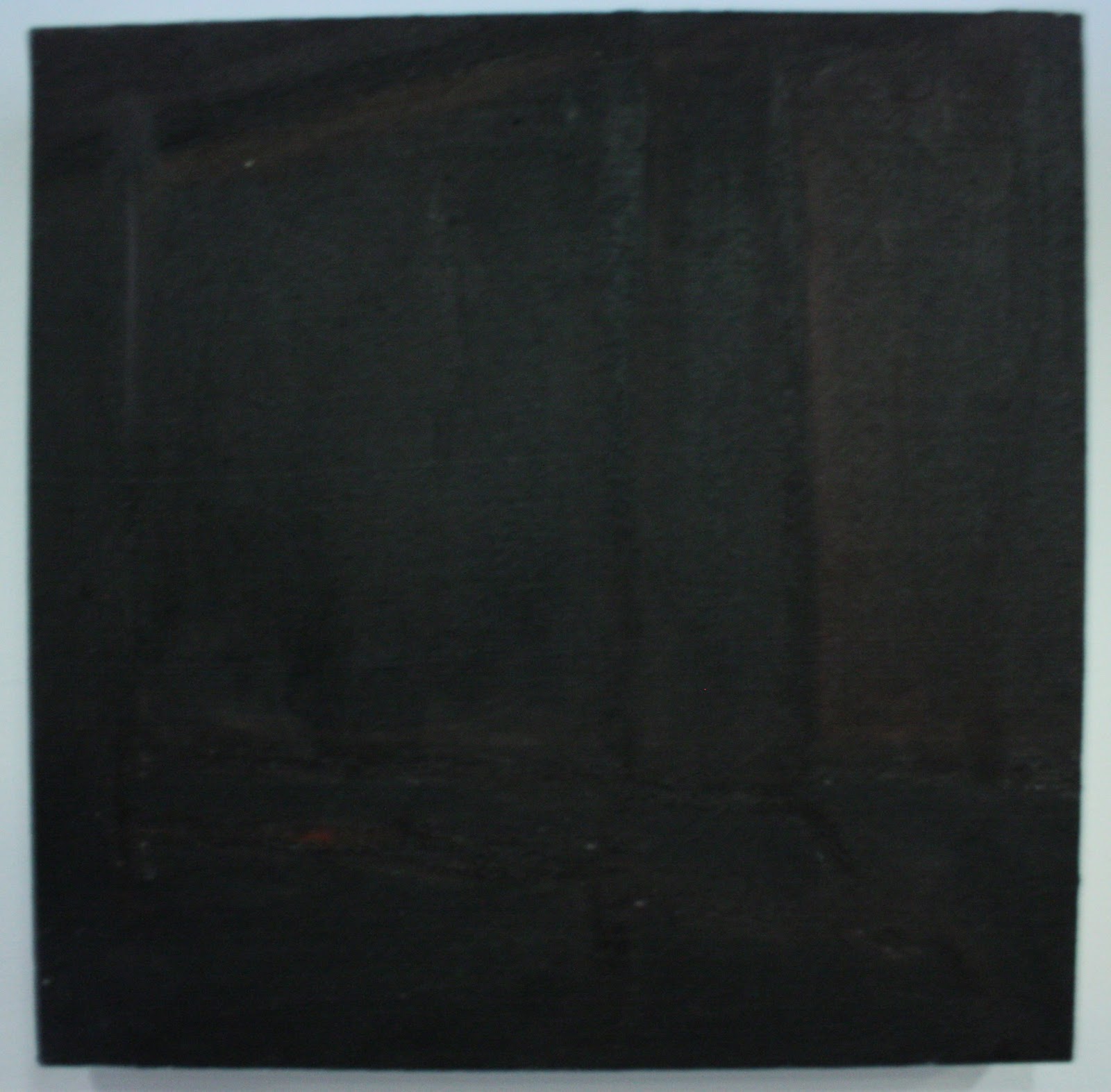
The following body of work is an attempt to eradicate everything that should give the viewer any sense of place or identity, it takes the minimalist approach in trying to tap into the idea of the liminal 'nothingness'


These works are removed  from almost all sense of representation  in order to offer more uncertainty to the viewer, and to eradicate any sense of belonging and eliminate any feeling of comfort the viewer may find in correlation to an object within the composition.


The works emulate so much ambiguity that the style of painting itself is now also in the liminal phase between abstract and representational art.


These works offer the viewer a glimpse of what they may interpret as an everyday object and the uncertainty of it ‘being’ or ‘not being’ while capitulating themselves to the psychological  space around these objects and offering them a taste of the liminal nothingness that may lie
ahead of them, reminding them
of the 'fragility' and scarceness of
of ones life.

Rothko - Tate Modern:

Rothko was influenced in this body of work by Michelangelo's Laurenhian Libarary in Florence, with its blind windows and deliberately  oppressive atmosphere. Rothko commented that Michelangelo ' achieved  just the kind of feeling i'm after- he makes the viewer feel like they are trapped in a room where all the windows and doors are bricked up, so that all they can do is butt their heads forever against the wall'

'Public Display - Tate Modern' 


In his mature work, Rothko abandoned specific reference to nature in order to paint images with universal association. by the late 1940s he had developed a style in which Hazy, luminous rectangles flout within a vertical format. Rothko wrote that the great artistic achievements of the past where picture f the human figure alone in a moment of utter immobility. he sought to create his own version of this solitary meditative experience, scaling his picture so that the viewer in enveloped in the subtly shifting, atmospheric surface.  


The Unilever Series: Miroslaw Balka:


'Black Box'- Miroslaw Balka
The latest commission in The Unilever Series How It Is by Polish artist Miroslaw Balka is a giant grey steel structure with a vast dark chamber, which in construction reflects the surrounding architecture – almost as if the interior space of the Turbine Hall has been turned inside out. Hovering somewhere between sculpture and architecture, on 2-metre stilts, it stands 13 metres high and 30 metres long. Visitors can walk underneath it, listening to the echoing sound of footsteps on steel, or enter via a ramp into a pitch black interior, creating a sense of unease.
Underlying this chamber is a number of allusions to recent Polish history – the ramp at the entrance to the Ghetto in Warsaw, or the trucks which took Jews away to the camps of Treblinka or Auschwitz, for example. By entering the dark space, visitors place considerable trust in the organisation, something that could also be seen in relation to the recent risks often taken by immigrants travelling. Balka intends to provide an experience for visitors which is both personal and collective, creating a range of sensory and emotional experiences through sound, contrasting light and shade, individual experience and awareness of others, perhaps provoking feelings of apprehension, excitement or intrigue.
'Miroslaw Balka’s black hole at Tate Modern is terrifying, awe-inspiring and throught-provoking. It embraces you with a velvet chill'.
'The Guardian'


Death- The ultimate uncertainty:

In correlation to the concept of 'uncertainty' and 'anxiety' the notion of death seems to hold a somewhat perpetual erudition.

blurred vision:

this is a combination of the notion of blurred vision with the dismissal of the figure. in order to try and further push the idea of uncertainty within the piece.

This piece was inspired by a piece called ‘black box’ created by the artist Miroslaw Malka. It portrays the idea of life and death. The light being life and the alley the journey which takes you to the darkness ‘death’. 

Saturday, 9 March 2013

Eradicating the figure:


This is an attempt at eradicating all figures from the composition. It instantly feels to be the way forward. The dismissal of the figure now allows the viewer to engage with the piece and imagine themselves within the depiction, a fundamental characteristic when dealing with individual persons subjective fear. however still seeing the tunnel leaves the viewer with a sense of comfort in knowing where one is. I must begin to push this concept of 'nothing' and 'not knowing' further. 


Phenomenological experience;

'I was walking home late at night and  I put a pair of my house mate's glasses on and suddenly I entered another world. A world of blur, an experience far out of my comfort zone. i now lost any sense of 'knowing' and began to re-evaluate anything i thought may or may not have been an object or a shadow around me'. 

'I was instantaneously uncomfortable and anxious'        

The figure:


 I still feel this set of work are emitting a feeling of empathy and in this sense  block the viewer from really interacting with the piece. the figure seems to be somewhat of a distraction.

David lynch - Rabbits:


This is  a short video by David lynch called ‘Rabbit’ a very atmospheric and strangely  scary and off-putting feel to it. That is created by the stage set (composition) lighting and missing information; such as the faces of the characters. This correlates to the notion of 'uncertainty' and  what is not there, it s missing information that keeps the mind guessing and questioning, you keep looking for it and begin to imagine in your own head of what it could be, the possibility’s, ‘the not knowing’.